
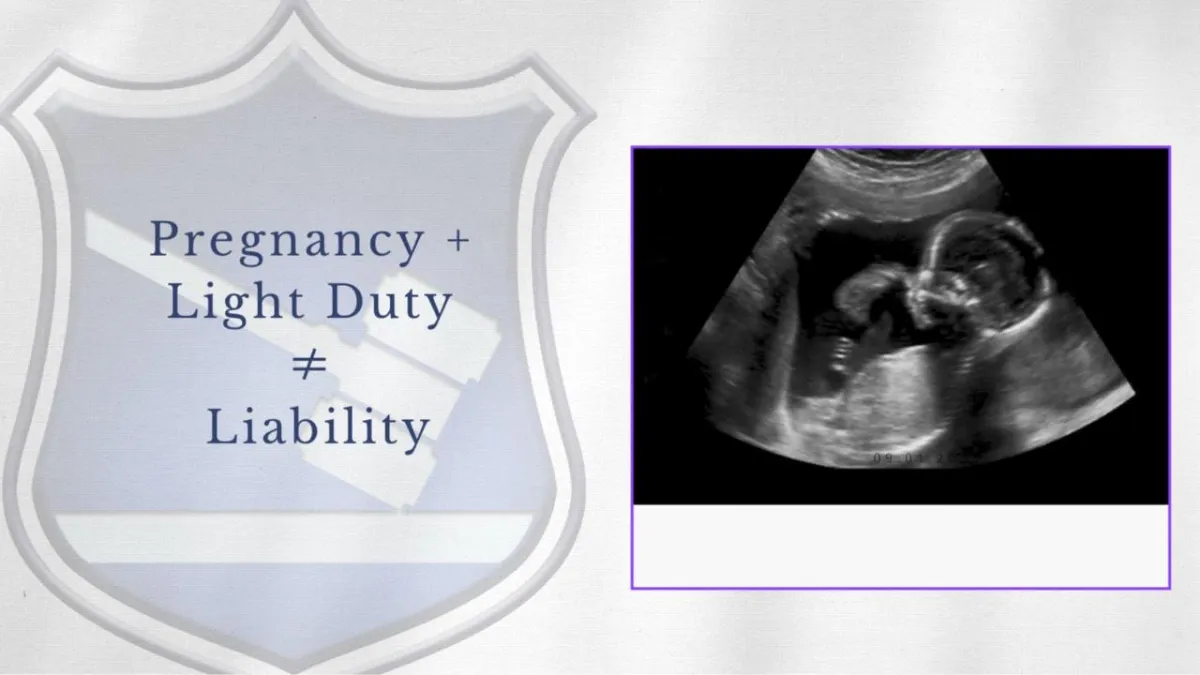
Pregnancy + Light Duty ≠ Liability
Here's the scenario: you are a female law enforcement officer, and you find out you are pregnant. You quickly ask yourself, "what happens when I tell my department I'm pregnant?" “When should I tell them?” “Will I lose my job?”
Well, there is a lot to unpack here.
The first question I ask my clients is this: What do you want your department to do or offer you when you tell them you are pregnant? This is important to define.
I hope you want to shift from active patrol (or whatever situation that puts you and your unborn child at an increased risk), and request an accommodation, or light-duty assignment, for the duration of your pregnancy.
Many women fear requesting an accommodation because it will impact their job in the long run. But as soon as you get pregnant, it's not just about you anymore.
The light duty assignment may involve handing over your badge and gun for a little while. Fine, that's acceptable. As long as your agency is not firing you or forcing you to take unpaid leave, you can and should take whatever light-duty job is available.
There are two reasons I say that.
First, when it comes to being pregnant, to having a child in your belly that you need to protect, you shouldn't be forced to make zero money during your pregnancy.
Second, you do want to be able to shift out of a job that could actively cause you physical harm, so don't be afraid to do that.
How are law enforcement agencies handling this?
Here is a real-world client example: a female officer's department told her they do not offer light duty to pregnant law enforcement officers claiming it is "because doing so is a liability."
When my clients come to me with that problem, here are the questions we start with:
1-Why? Why are they claiming it is a liability, and on whose authority?
2- How many employees are in that department? It matters because federal statutes protect you in situations like this if there are 15 or more employees in your department. That means ALL employees, not just the sworn officers.
I'd bet that almost every police department has at least 15 people.
If they say they do not have light duty options, they may be saying you have to take unpaid leave for the entirety of your pregnancy.
However, unless your agency can prove that a light duty assignment is somehow causing an "undue hardship" in allowing you to shift to something like sitting at the front desk, answering non-emergency phone calls, etc., it is not legal.
Yes, light duty is an option.
No, they cannot force you to take unpaid leave.
No, it's not a high liability.(p.s.- nor can the agency prevent you from getting your prior, certified job back after you have the baby. But I'll cover that at a later date)
Is the denial illegal?
Being pregnant does not kick in federally protected rights unless you have a high-risk pregnancy. However, they can't treat your request for light duty any differently than they would treat someone with a non-pregnancy-related light-duty request.
If you called me to say this is happening, here is where we would start- find out how they are treating other light-duty requests made by non-pregnant people. Getting injured on the job is not unusual in law enforcement, so you should be able to find examples of light-duty assignments. If your department is small and this is less common, ask your Human Resources department.
You want to know whether they treat pregnancy-related requests differently than on-the-job injuries (a.k.a. worker's comp-related issues).
And if they are, that's discrimination based on pregnancy, and they can't do that. And there are actions you can take.
The first step is to follow your agency's protocol for reporting discrimination, that you are "being treated differently because you're pregnant." You must notify your agency of a perceived discriminatory act and ensure you are using that language to ensure you are kicking in the federal protections. If this doesn't automatically correct the problem, you need more help.
Hire An Attorney
Just because they are cops does not mean they know ALL laws.
Often, a simple letter from an attorney could correct any erroneous assumptions about the laws.
Sometimes law enforcement agencies can do foolish things, and you must stand up for yourself. No one will do it for you.
That's why I want you to know what your options are. I want you to understand what information is out there so you can make the decision you feel comfortable making. Also, I want you to know what your department should offer to keep you and your unborn baby safe.
Contact me if you need more help. I offer free 15-minute evaluations to help you determine if you need an attorney's help.
You shouldn't be made to feel less than just because you're pregnant or female. You'll always fear being looked at as different and not being treated fairly, but no matter what, we are different.
We are females in a predominantly male industry, and "they" don't always understand the rules, laws, and protections.
I can help.
Don't sit back and take it. If you don't know what to do, message me, and I'll help.
Thank you, all of you, and each of you, for the job that you're doing. You're a courageous person. Hold your head high. You deserve it.
